
Struggling to choose between fiber laser and waterjet cutting technology? If you’re trying to decide between the two, or wondering whether it’s time to add one to your shop, it’s important to understand how they compare. In this guide, we’re breaking down the differences between fiber laser vs. waterjet solutions. With this knowledge in mind, you’ll be able to make an informed decision for your business.
What Is Fiber Laser Cutting?
Fiber laser cutting uses a high-powered laser beam generated by fiber optic technology to cut through materials. Diode lasers pump energy into fiber optic cables, which amplify light and create an extremely focused, high-intensity laser beam. When this focused beam hits the material, it heats the material to its melting point or vaporization temperature almost immediately. A gas (usually oxygen, nitrogen, or compressed air) is blown through the nozzle to remove the molten material from the cut.
What Is Waterjet Cutting?
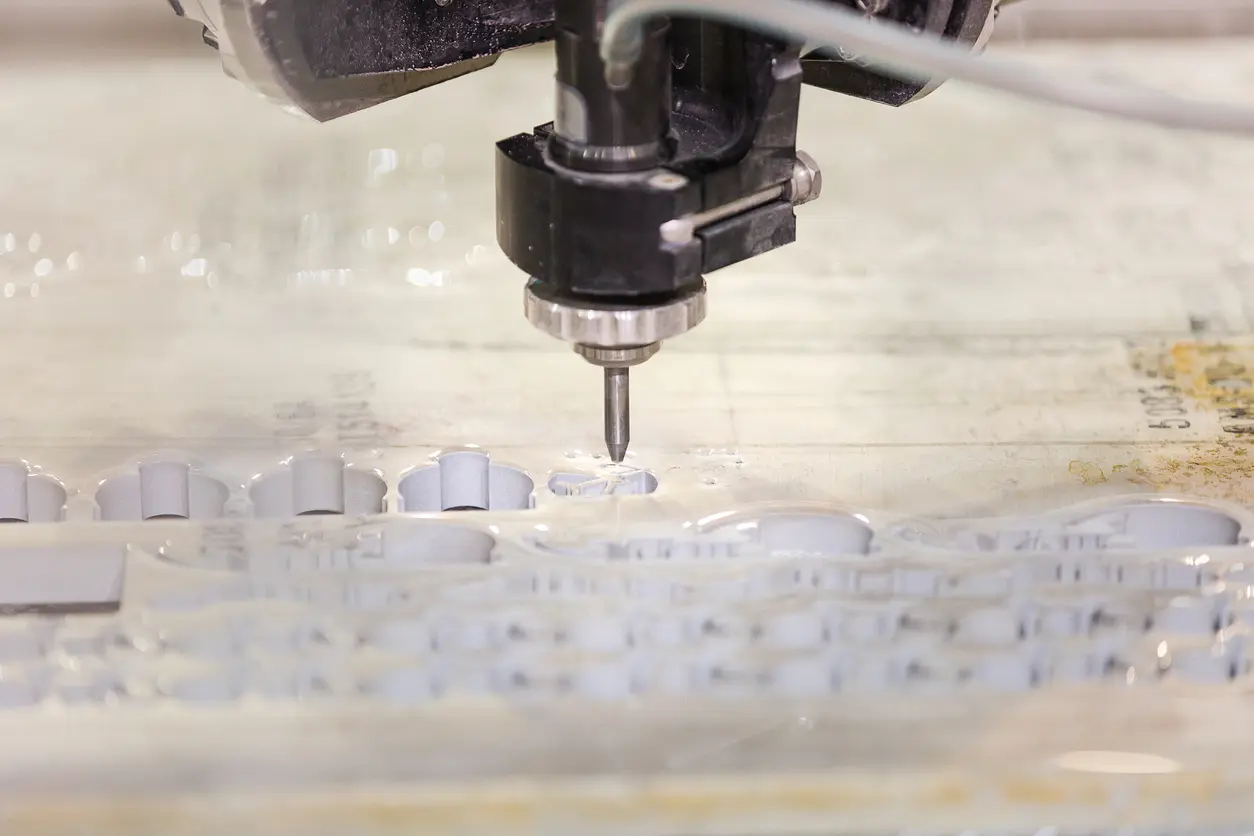
Waterjet cutting uses a high-pressure stream of water, mixed with an abrasive particle like garnet, to cut through materials. Water is pressurized to extremely high levels and then forced through a small opening in a nozzle. This creates a strong jet stream that then cuts the workpiece.
Fiber Laser vs. Waterjet Cutting Systems: What’s Best?
As noted above, fiber laser and waterjet equipment are extremely different. If you’re trying to decide between the two, keep these four considerations in mind:
Material Versatility
If you’re cutting a wide variety of materials, a waterjet solution is likely right for you. Waterjet cutting is an extremely versatile cutting technology; it can cut almost any material, whether it be metal or non-metal. AKS waterjet machinery can cut:
- Mild steel
- Tool steel
- Stainless steel
- Aluminum
- Titanium
- Copper
- Brass
- Inconel
- Hastelloy
- Armor plate
- Composites
- Laminates
- Ceramic
- Stone
- Marble
- Granite
- Plastic
- Rubber
- Foam
Conversely, fiber lasers are primarily used to cut only metals, though they can be used to cut other select materials. If you’re going to be cutting on a range of materials, waterjet is likely right for you.
Material Thickness
Typically, fiber lasers can cut up to about 1 inch on carbon steel, 0.5 inches on stainless steel, and 1 inch on aluminum. Waterjets can cut an exceptionally wide range of thicknesses, up to about 12 inches thick.
The Heat Affected Zone (HAZ)
With fiber laser technology, you’ll need to be mindful of the heat affected zone (HAZ). During the cutting process, the area between the melted part and the unaffected base metal sees chemical and structural modifications. This section, known as the HAZ, can cause the cutting edge to become brittle and more prone to fractures. It may also negatively affect fatigue performance. Waterjet cutting is a cold cutting process, which means that it will not create a HAZ like fiber will.
Want to learn more about the HAZ? View our in-depth blog here.
Edge Quality
There are a few considerations to keep in mind when it comes to edge quality for both fiber laser and waterjet machinery. Fiber laser cutting produces extremely smooth, clean edges on thin to medium materials with tight tolerances. However, it does create a small heat-affected zone that may cause discoloration or hardening. Edge quality will degrade on thicker materials, where you might see striations or dross buildup. Because waterjet cutting is a cold process, it avoids any heat-related issues. But edges may show slight striations from the abrasive stream.
For thin materials, it may be best to opt for a fiber laser, but waterjet excels when you need to cut thick materials without compromising material properties.
Fiber Laser vs. Waterjet: What’s Right for You?
The fiber laser vs. waterjet debate ultimately depends on your specific needs. If you primarily work with thin to medium-thickness metals and need the tightest possible tolerances and smoothest edges, a fiber laser may be your best choice. However, you will have to consider the HAZ and how that may affect your part performance.
If you need to cut a diverse range of materials or work with materials beyond 2 inches, waterjet cutting may be the best fit for you. Waterjet is also the clear winner when working with heat-sensitive materials or when you absolutely cannot introduce a heat-affected zone that could alter material properties.
Have questions about which equipment is best for your business? Reach out to our team today for insight.
Explore Waterjet Cutting Machines from AKS Cutting Systems
AKS Cutting Systems is one of the most trusted names in waterjet and plasma cutting technology. With over 100 years of experience, we’ve worked with businesses large and small to get the right system for their needs.
We offer a wide range of waterjet and plasma cutting machines. Paired with the best consumables, our expertise and Made-in-America machinery can help you improve cut quality and ultimately enhance the performance of your cutting operations. Contact us today to learn more.